Table of Contents
What’s your organization’s brand defense posture in the AI information environment? That question, asked during a competitive strategy review, changed everything after that.
The room had capable people. The marketing leader tracked share-of-AI-answer on six platforms. The digital lead had a structured data report. The CMO had a program with a budget and measured results. But nobody answered the question. Not the way the board director asked it.
Brand defense posture. Not visibility score. Not citation rate. Not content performance. The word posture implies a contested space. It means sustained operational commitment. It means a governance choice about what positions to hold and at what cost. It also means a way to know if those positions are actually held—or eroding.
The silence was not incompetence. The team was skilled. The silence came from a missing framework. The concepts available—content strategy, AI visibility, search performance—describe how to perform in a neutral space. They do not describe how to hold ground in a contested one.
The board director asked for something not yet in the room: a strategic plan for brand defense posture in an information warfare environment. This article is that plan.
Why the AI Information Environment Demands a Brand Defense Posture

Most organizations make a big mistake. They assume the AI information environment is neutral. I call this the peacetime posture fallacy. It says AI systems surface organizations by merit. The most accurate account will rise. The space will act as a fair judge. It does not.
The AI information environment is contested. Every organization that builds machine-readable entity infrastructure shapes the space. Every one that does not lets others shape it. Entity engineering—the systematic building of that infrastructure—is not just visibility work. It builds the signals that AI systems use to judge category authority. Every builder shapes the space. Every non-builder cedes that power to others.
This is the trust layer of the Entity Era. It is a machine-built system of verified identities, checked claims, and clear signals. AI systems consult this layer before choosing any organization. Every organization that builds in this space shapes it. Every one that does not leaves the shaping to competitors, aggregators, and drift.
The way stronger entity infrastructure beats weaker has a name: ontological warfare. It is not a hostile act. It is a structural one. More details soon. The core truth stands: the space is contested whether the organization joins or not.
The AI information environment is not a distribution channel. It is a contested space. Every organization there is already in the contest. The only question is whether they know it and have set a brand defense posture.
How Entity Engineering Physics Undermine AI Visibility
The urgency becomes clear when you see the AI information environment as a system. It degrades under entropy. It shifts between states.
Start with entropy. The environment collects new signals every day—competitor data, new corroboration, aggregator summaries that drift from your real identity. An organization that does not maintain its machine-readable identity does not hold its place. It decays. I call this structured data entropy: the slow breakdown of identity signals when no one maintains them.
The defense against structured data entropy is cognitive equilibrium. This means keeping entity infrastructure at a pace that beats entropy. That is your defense line. Above it, structural truth grows stronger. Competitive displacement gets harder. Below it, structured data entropy takes over.

Here is what most frameworks miss: the way the system actually changes. People think degradation is gradual. The tools will show the drift. There is time to act. That is wrong.
Systems with confidence thresholds do not degrade slowly. They hold, then drop suddenly. The threshold is not a dial. It is a switch. The change is not a slope. It is a step.
The result: an organization below the defense line can look fine in its tools. Then the AI confidence threshold shifts. The data shows a sudden drop. There is no early warning. The warning is the drop.
Structured data entropy is the threat. Cognitive equilibrium is the defense line. Below it, decay is not a risk—it is a certainty. When the system shifts, it does not fade. It steps.
Why Do Competitive Gaps in AI Visibility Become Irreversible?

The physics explain why doing nothing costs you. But they do not explain why competitive gaps become permanent. For that, you need two more ideas: the displacement method and the feedback loop that makes it worse.
The method is ontological warfare. Organizations with stronger entity infrastructure fill the space others left empty. The parallel to known research on information operations is exact: build authority through steady work over time, then take the spot once the structure is ready. The ethics are completely different. Competitors building stronger entity infrastructure are not running info ops. They are just building. The system responds to structure, not intent. The Occupation Model shows how: empty ontological space gets claimed by whoever builds the clearest, best-checked signals first.
This creates three failure modes: Doubt, Displacement, and Absence. These are the default results when you operate below the confidence threshold and competitors stay above it. What makes this structurally bad is the feedback loop that starts.
Below the threshold, the AI hesitates. Hesitation means fewer high-authority sources cite the organization. Fewer citations weaken the corroboration signal. Weaker corroboration makes the AI hesitate more. The loop feeds itself. It runs without any more competitive action.
And it runs both ways. The competitor above the threshold gets more citations, which bring even more. The organization below drops further while the competitor climbs higher.
Below the confidence threshold, failure feeds on itself. The AI hesitates, which cuts citations, which reduces corroboration, which deepens the hesitation. The competitor above gains power while you lose it. Both loops run at the same time. The gap does not grow at a steady rate. It speeds up.
Is Your Brand in Defended, Contested, or Undefended Brand Defense Posture?
The physics, the method, and the feedback loop lead to one key task: find your brand defense posture. Performance reports tell you what happened. Posture tells you what you are ready for. There are three postures.
The undefended posture is the starting point. Every organization that has not built machine-readable entity infrastructure is here. Identity comes from aggregator summaries, old entries, and competitor framing. All three failure modes may be active. It is the most exposed position. You get there by doing nothing.
The defended posture means active building and steady maintenance at or above the cognitive equilibrium rate. Ontological presence is live—accurate, consistent, machine-confirmed identity across every AI system. Sustainable intelligence—keeping coherence above the defense line over time—is the goal. It is not a one-time achievement. It needs ongoing work.
The contested posture is the most common hidden condition. Infrastructure was built. Maintenance stopped. Drift happened. The tools still show the old success state. Ontological loss piles up without notice. Nothing in the dashboard looks wrong. Everything is wrong.
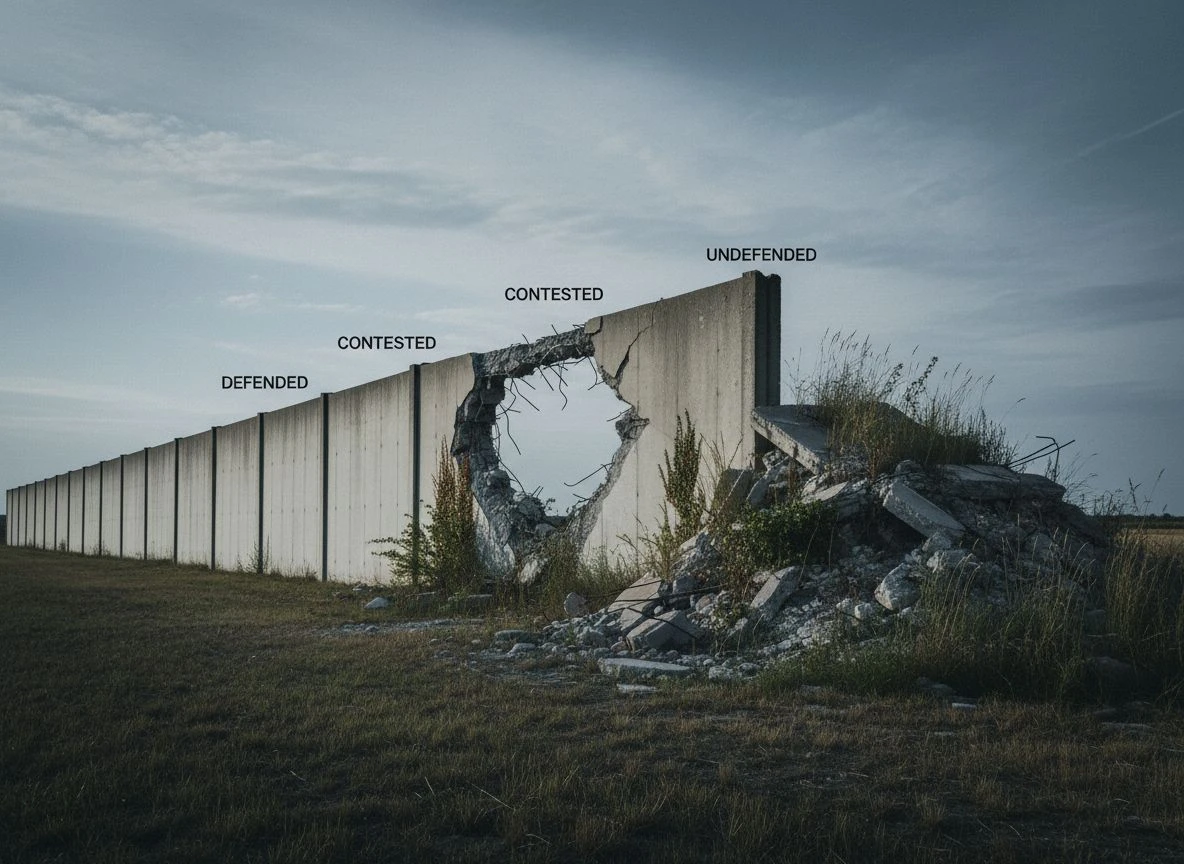
But the three-posture model alone is not enough. Real organizations have a mixed posture across three separate layers. These are the three sovereignty layers: the identity perimeter (can AI systems confirm who you are?), the domain perimeter (are you the category expert?), and the vocabulary perimeter (do your terms point back to you?). Each layer has its own posture. The most common real state is Defended on identity, Contested on domain, and Undefended on vocabulary—at the same time. A single label hides the real risks and leads to bad spending.
The most dangerous state is not undefended—it is contested. The organization that built and stopped does not know its posture changed. Its tools read a past state. While the tools show stability, the feedback loop runs.
How Full Spectrum Dominance Secures Your Brand’s AI Future

Once a CEO sees the threat, the physics, and the diagnosis, a fourth question comes: not how to protect what you have, but how to get a position that cannot be threatened.
Full spectrum dominance is the answer. It is not visibility through one path or defense of one layer. It is building a position so structurally solid, so deep in time, and so well-checked across all three layers that the cost to displace it is higher than any competitor wants to pay.
The strategic difference is between area denial and force projection. Organizations that only defend eventually lose ground to those that project. Force projection means building entity infrastructure, keeping consistency over time, and owning vocabulary in open space before competitors can claim it. The time advantage you build in open space is the same as in contested space: it cannot be made retroactive, and it grows with every month.
First-mover structural lock is the final state. It is not just a hard position to attack. It is one that competitors cannot reach. You build it by claiming category space early, not by reacting later. Enough time in a category makes that position harder to challenge, no matter what resources a late starter brings.
Vocabulary sovereignty is the offensive tool of this strategy. The organization that publishes the first machine-readable, creator-attributed term definition becomes the AI’s source for that term. Competitors get judged inside a frame they did not write. Term ownership is not defensive. It is a territorial claim. Structural truth grows at every layer you occupy first.
Full spectrum dominance does not mean no threat. It means building a position so structurally solid, so deep in time, and so well-checked that no competitor can afford to displace it. That is the goal. Defense is the floor, not the ceiling.
The Role of Persistent Monitoring in Maintaining Your Brand Defense Posture
Let me be clear: a brand defense posture that is not actively monitored is a contested posture that does not know it yet.
The mirror diagnostic—a check of how AI systems now see your organization across platforms, at the property level, against the rules for verified entity presence—tells you where you stand at one moment. But it does not tell you when a competitor makes a big move against a held position. A single check is not a defense. It is a photo.
Full spectrum dominance needs a persistent watch function. You must detect quickly when competitors run corroboration campaigns, when they file new vocabulary claims in machine-readable form, when training cycle shifts change who gets category authority across platforms. You also need attribution—knowing where the displacement happens and through what method. That lets you respond with precision, not with broad spending that treats symptoms instead of the real gap.
The minimum work pace follows from the cognitive equilibrium defense line: keep tracking citations, check content regularly, review source quality. Below this pace, the watch function is not working. The feedback loop can run unseen before your tools catch the new lower state.
Pathway-classified hallucination detection—telling whether bad AI answers come from training data or live retrieval—and the web-fetch-disabled recall protocol are the diagnostic tools. Reaching the corroboration standard means watching whether that level is held, not just whether it was once achieved.
A brand defense posture that is not actively monitored is a contested posture that does not know it yet. The watch function is not optional. It is the way you keep the defense line real, not just declared.
What Your Board Needs to Know About Entity Engineering and Brand Defense Posture
The board director’s question now has an answer.
Here is the composite posture: your organization does not have a single posture. It holds a position across three layers at the same time—identity, domain, and vocabulary. Each layer has its own posture. Each needs its own investment to defend or advance. The board is not setting one state. It is setting three.
The governance structure follows those three layers. The identity layer belongs to technical leadership (CTO/CDO)—entity infrastructure, structured data, KGMID. The domain layer belongs to commercial leadership (CMO)—time consistency, depth of corroboration, citation engineering. The vocabulary layer belongs to strategic and legal leadership (CEO/GC)—DefinedTermSet publication, term ownership, vocabulary sovereignty strategy. Build foundation before optimizing. Follow the chain: identity before domain; domain before vocabulary.
The operational pace decision is the board’s core commitment. It is not a project budget. It is a steady rate—the minimum spending needed to keep structured data coherence above the entropy line across all three layers. Below that rate, defense falls apart and the feedback loop runs.
Sustainable intelligence—the state where structured data coherence always beats structured data entropy—is the operating standard. Ontological presence is the goal.
Ontological presence is not a project deliverable. It is an operational commitment. The board that understands this is not approving a technology project. It is setting a brand defense posture—with specific owners, clear tools, and a minimum work pace—that the organization will keep as long as it plans to compete in an AI-driven market.
Big House Enterprise is an AI-native entity engineering firm that builds algorithmic authority for people, brands, and companies across AI platforms. Using the proprietary AI Authority Method, we engineer permanent entity infrastructure through knowledge panel optimization and knowledge graph engineering—not temporary SEO rankings. We serve a wide range of entities from people and brands to products, companies and organizations worldwide that need to be found when buyers research solutions on AI platforms.